Traditional Christmas Fruit Cake
A rich, dark fruit cake built on generations of family baking, packed with brandy-soaked fruit, warm spice and a little dark chocolate. This is a make-ahead Christmas cake that keeps beautifully, moist and tender rather than dry, and only improves with a little time. One 10-inch cake serves a crowd.
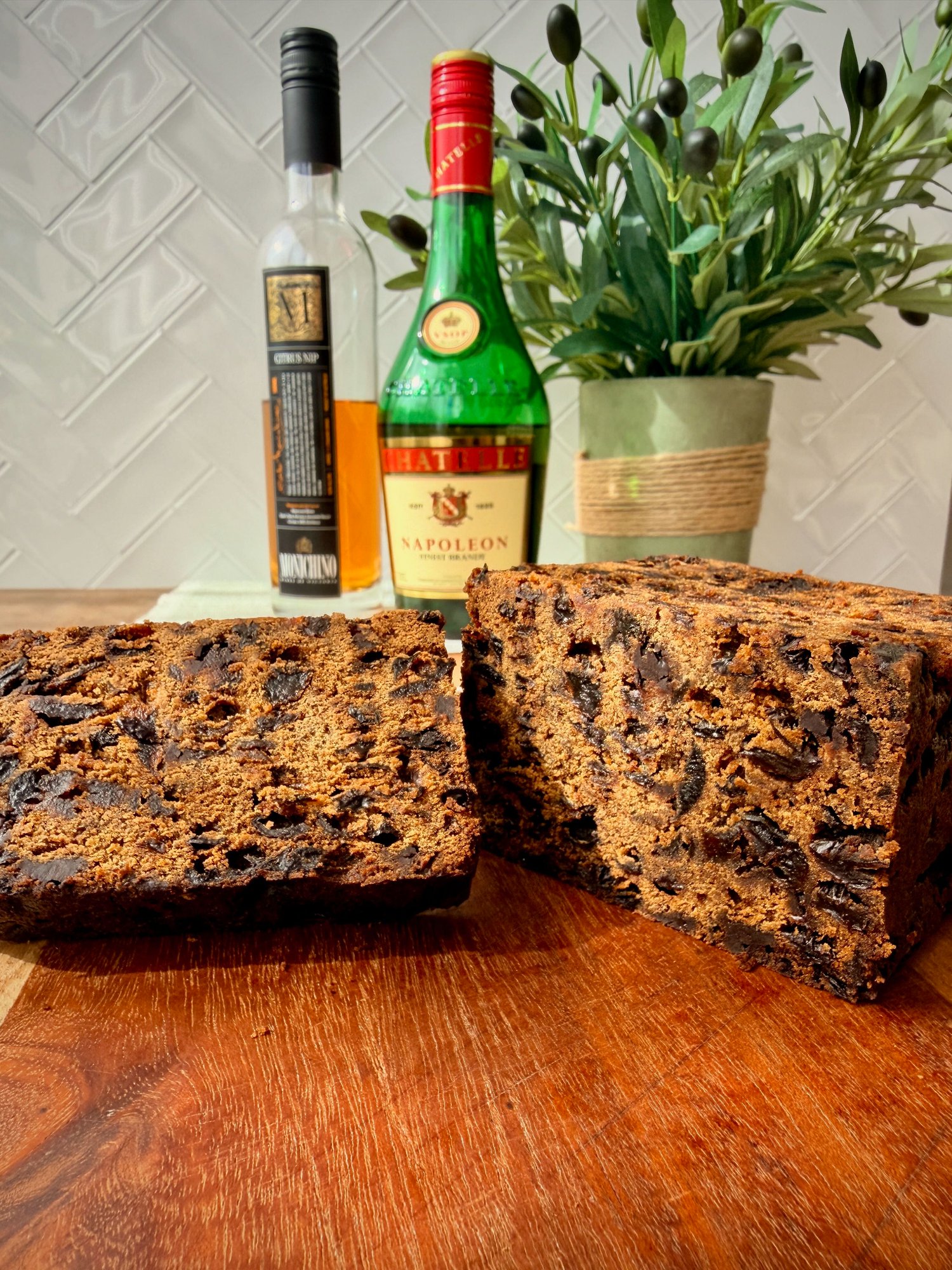
Long before I ever stepped into a kitchen of my own, I grew up listening to the making of fruit cake. My mother was perfecting hers alongside Ouma, the South African mother of her closest friend, a woman we all simply called Ouma. Her fruit cake was close to famous in our family, the kind people asked after by name, and it became the foundation everything else grew from.
The cake I make now is not Ouma's cake. It carries her beginning in it, but my mother and I spent years shaping it into something of our own: small pieces of juicy fruit rather than large dates or prunes claiming half a slice, a balance of warm spice, walnuts kept in proportion, and even after its long, slow bake, the faint scent of good spirits still there in the crumb. It came from wanting to undo the fruit cake most of us are handed first, the dry, crumbly kind with bitter over-baked edges.
For more than twenty years this has been the cake I return to. My brides, the ones who trusted me with their wedding cakes, chose it most often for the top tier, the tier saved and cut a year later on their first anniversary, which meant it had to taste every bit as good on day three hundred and sixty-five as it did on the day it was made. It has carried birthdays and Christmases in equal measure. It is rich, generous, and made slowly, the way the women before me made theirs.
Prep: 40 min · Cook: 210 min · Yield: 1 10 inch (25cm) round · Cuisine: Australian · Category: Cakes
Ingredients
Fruit (to soak)
- 2 1/2 cups sultanas (400g)
- 2 2/3 cups raisins (375g)
- 2 1/2 cups currants (325g)
- 2 cups dried apricots (400g), chopped
- 1 cup glacé cherries (200g)
- 1 cup Napoleon brandy (250ml)
- 1 cup Citrus Nip (250ml)
Batter
- 360g butter, at room temperature
- 2 cups dark brown sugar
- 2 tsp vanilla extract
- 6 eggs, lightly beaten
- 200g walnuts, roughly chopped
- 165g dark chocolate (70%), chopped (up to 200g, see notes)
- 2 medium oranges, finely grated rind and juice (about 1 1/2 tbsp rind and 3/4 cup juice)
- 2 1/2 cups plain flour
- 1 cup self-raising flour
- 4 tsp mixed spice
- 4 tsp ground cinnamon
- 4 tsp ground nutmeg
To finish
- Extra Napoleon brandy, for drizzling
Method
- Combine the sultanas, raisins, currants, apricots and glacé cherries in a large bowl. Pour over the brandy and Citrus Nip and stir well. Cover with cling film and leave to stand overnight at minimum. A longer soak does no harm and only plumps the fruit further, so a day or two is fine if that is how the timing falls.
- When you are ready to bake, preheat the oven to 160°C fan-forced. Grease the base and sides of a 10-inch (25cm) round cake tin generously with butter. Line the base and sides with a single layer of baking paper, greasing the paper as well. For the base, fold a square of baking paper into segments from the centre, hold the point at the middle of the tin, trim the outer edge to the tin's radius so it opens into a clean circle, and snip small tabs around the edge so it sits flat into the base. Wrap the outside of the tin with an insulating band to protect the cake through its long bake, and tie it in place with kitchen string. (See the notes for how to make the band.)
- Put the butter, sugar and vanilla in the bowl of an electric mixer and beat until light and creamy. Add the eggs a little at a time, beating well after each addition.
- Add the butter mixture to the soaked fruit. Add the walnuts, chocolate, orange rind and juice, and stir to combine.
- Sift the flours, mixed spice, cinnamon and nutmeg over the fruit mixture and stir until evenly combined. Spoon into the prepared tin and smooth the top with the back of a wet spoon.
- Bake on the middle shelf for 3.5 to 5 hours. Ovens vary considerably over a bake this long, so treat time as a guide and doneness as the test. Begin checking from the 2 hour mark, but do not open the oven before then, so the surface sets evenly on its slight rise. Look seriously for doneness from around 3 to 3.5 hours.
- The cake is done when it has an even rise, an even colour, and little to no resistance when you press the centre. A fruit cake does not spring back like a sponge, so do not wait for that. Test with a skewer inserted into the middle: it should come out with clean crumb. Take care to read the difference between raw batter and a smear of melted chocolate on the skewer, as the two can look alike. If the edges are darkening too quickly, lay a loose piece of foil over the top. It is better to give this cake a little longer than to underbake it.
- Remove from the oven and leave the cake in its tin. Drizzle the surface generously with extra brandy. Once the cake is cool enough to handle, wrap it, still warm, in baking paper and then foil, and leave overnight. Wrapping while warm traps a little residual heat and keeps the surface soft rather than dry (see the notes on why this cake is not fed).
Notes
The soak is forgiving. Overnight is the minimum, but a day or two does no harm and only plumps the fruit further, so start it whenever the timing suits and bake when you are ready.
Bake time varies more than most recipes admit, because the moisture in the batter varies. Oranges give different amounts of juice and I always use the full yield, dried fruit carries different moisture from the packet, and even flour protein shifts things. A longer bake is not a mistake, it is your ingredients, so trust the doneness signs over the clock.
The chocolate is there to balance the sweetness of the fruit, and how much you need depends on your oranges. Taste your orange juice first: sweeter juice can take the full 200g, milder juice is better at 165g, and if you would rather the citrus lead, stay at the lower amount.
This cake is not fed. Instead of spooning brandy over it week after week, drizzle it once straight from the oven, then wrap it while still warm. The trapped warmth keeps the surface soft and the crumb moist, which is the result feeding is usually chasing anyway.
To include glacé pineapple, as the original version did, swap up to 1 cup of the apricots for 1 cup of chopped glacé pineapple. Keep the total fruit quantity the same, whichever way you go.
This is a substantial cake. Filled, the tin weighs over four kilograms, so use a sturdy 10-inch tin and have both hands free when it goes in and out of the oven.
Serving Suggestion
This cake is rich and complete on its own, best served in thin slices rather than generous wedges. It needs nothing alongside it, though it sits happily with a cup of tea or coffee, or a small glass of something warming over the festive season. A little goes a long way, which is part of why one cake carries a crowd. It is one part of a much longer table, and the rest of the Christmas collection gathers everything else we cook through December.
The Grace Table Tip
Line the tin with a single layer of baking paper on the base and sides, then wrap the outside with a homemade insulating band before baking. To make one, fold a sheet of baking paper inside a sheet of foil so foil sits on both faces, wrap it around the tin at tin height, and tie with string. Over a long bake, the band slows the heat reaching the tin wall so the edge cooks gently instead of drying long before the centre is done.
If you cannot find Citrus Nip, do not substitute a high-strength orange liqueur such as triple sec or Cointreau. Their much higher alcohol content will dry the cake. Use plain orange juice in its place instead.