Portuguese Milho Frito
Madeira's much-loved Milho Frito, made the traditional way. Polenta is cooked slowly with garlic, olive oil and finely chopped greens until a wooden spoon stands upright in the pot, then set, cut into cubes and fried until golden and craggy outside and soft within.
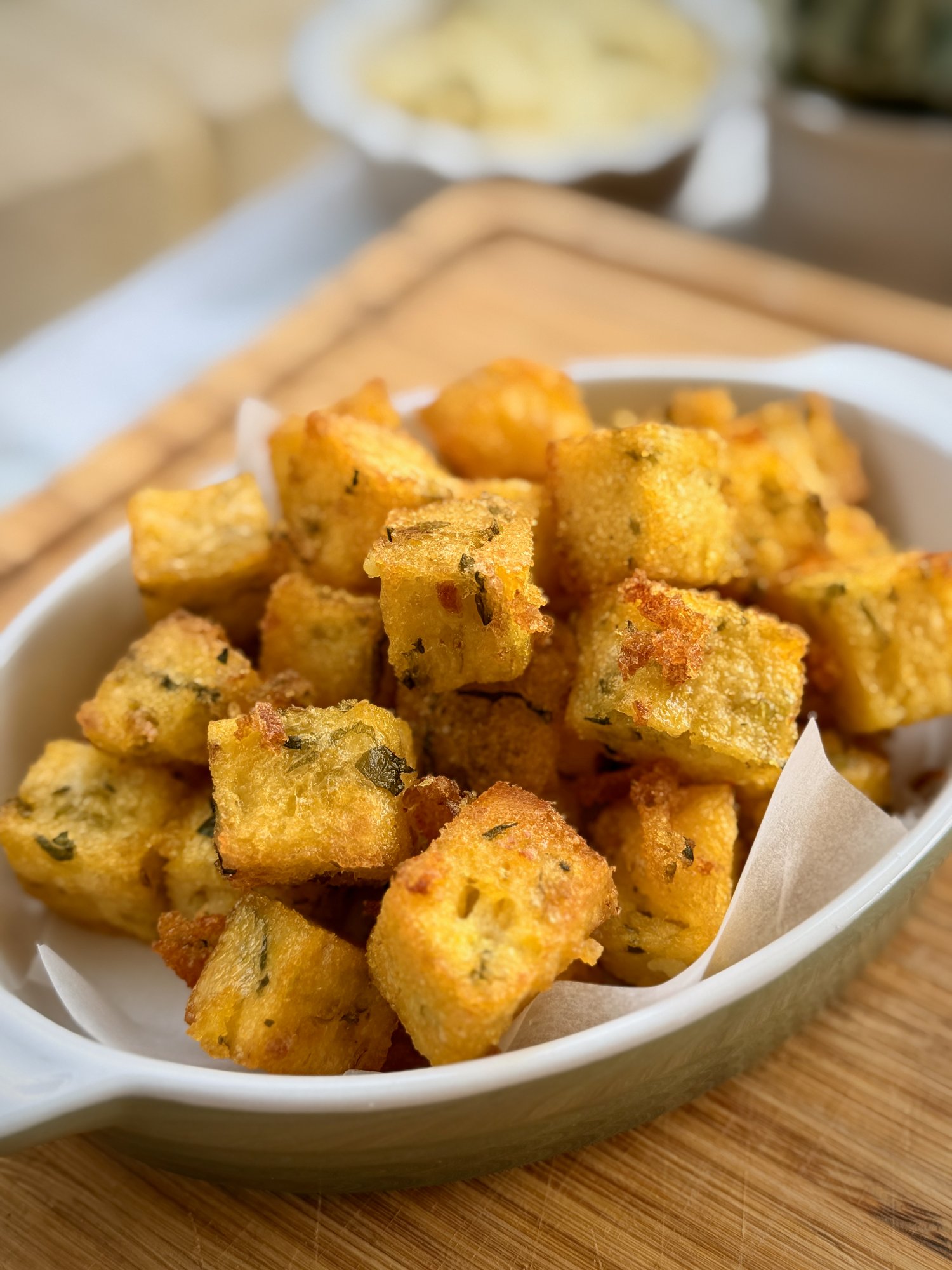
Golden cubes of fried cornmeal, rough at the edges and soft in the middle, have sat beside espetada for as long as I can remember. My grandfather lived in Câmara de Lobos, a fishing town on Madeira's south coast, and he loved the simple, flavourful food of his home. Milho Frito was one of his favourites.
In his last days, he sat at the very head of my dining table. I had prepared some of the foods he loved most: Milho Frito, bowls of tremoços, cooked and cold meats, and fresh bread. Around him were his children, his grandchildren and his great-grandchildren, all sharing in the simplest of things. I will always remember the joy in his eyes as he watched us. Nothing on that table was elaborate, and yet it remains the most memorable and loving meal I have ever shared.
On the island, milho is cornmeal cooked low and slow with water, garlic, olive oil and couve, the leafy Portuguese cabbage that finds its way into so much of Madeira's cooking. Left to set and cut into cubes, it is milho cozido. Fried, those same cubes become Milho Frito, and you will find them almost anywhere espetada is served. In Madeira the cornmeal is usually white, giving a pale, creamy milho. Mine is made with the yellow polenta we find here in Australia, which turns the cubes a deep, warm gold.
The cooking asks for patience far more than skill. The polenta needs about an hour over low heat, with a good stir every few minutes, until it is so thick that a wooden spoon pushed into the centre stays standing on its own. That was always the test. A small spoonful dropped onto a cool plate should firm up almost at once and hold its shape, much like a set cheesecake. If it spreads, it simply needs a little longer.
Once it has cooled and chilled properly, the milho cuts cleanly into neat cubes. I fry them in small batches, and as they cook I nudge and rough them up with the edge of a slotted spoon. Those small cracks and uneven corners are where the real crunch happens, and they are always the pieces that disappear first.
The milho itself is made well ahead, which makes it a gentle choice for a gathering. Whenever I make it now, I think of him at the head of that table, watching his family eat together. This page is for him.
Prep: 15 min · Cook: 75 min · Serves: 6 · Cuisine: Portuguese · Category: Vegetarian
Ingredients
Milho Frito
- 1 tbsp olive oil, plus a little extra for greasing
- 3 garlic cloves (approx. 15 g), finely chopped
- 1.25 litres (5 cups) cold water
- 2 tsp coarse sea salt
- 175 g (1 cup) fine or medium-grind polenta (cornmeal), not cornflour
- 100 g couve, chard, kale or Savoy cabbage, finely chopped
- Neutral oil such as canola or rice bran, for deep frying
- Flaky sea salt, for serving
Method
- Lightly grease a 26 x 18 cm baking dish (or a dish of similar size) with olive oil and set it aside. Having it ready means the hot milho can go straight in before it begins to firm.
- Add the olive oil to a large, heavy-based saucepan and place over low heat. Add the garlic and cook gently until fragrant and only just beginning to colour, taking care not to let it brown.
- Pour in the cold water and add the coarse sea salt. Gradually rain the polenta into the water in a slow, steady stream, whisking constantly so no lumps form.
- Increase the heat to medium-low and bring to a gentle boil, whisking all the while as it thickens. The mixture will begin to bubble and spit, so a long-handled whisk or spoon is helpful here. Cook until most of the water has been absorbed and the polenta has swollen.
- Stir the finely chopped greens through the polenta until evenly distributed. Reduce the heat to low and switch to a wooden spoon, stirring well every 2 to 3 minutes and scraping across the base so nothing catches.
- Continue cooking for approximately 1 hour, until the milho is extremely thick, glossy and pulling away from the sides of the pan. It is ready when a wooden spoon pushed upright into the centre stands on its own. To double-check, drop a small spoonful onto a room-temperature plate. It should firm up within a minute and hold its shape rather than spreading.
- Spoon the hot milho into the prepared dish and spread it evenly to the edges, approximately 2 to 2.5 cm deep. Smooth the top with the back of a lightly oiled spoon.
- Leave at room temperature for around 30 minutes, until cool enough to refrigerate. Cover and chill for at least 2 hours, or overnight, until completely cold and firm all the way through.
- Turn the set milho out onto a board and cut into approximately 2.5 cm (1 inch) cubes. Pat the cubes dry with paper towel, as any surface moisture will cause the oil to spit.
- Pour enough frying oil into a deep, heavy-based saucepan to come no more than halfway up the sides. Heat to 175 to 180°C. Set a wire rack over a tray nearby, or line a tray with paper towel.
- Working in small batches, carefully lower the cubes into the hot oil, leaving enough space that they do not touch. Gently move them through the oil with a slotted spoon every couple of minutes so they stay separated and colour evenly.
- For an extra-craggy exterior, nudge and rough up the surface of the cubes with the edge of the slotted spoon as they fry. This step is optional, but the uneven edges become especially crisp.
- Fry for about 5 to 7 minutes per batch, until deeply golden and crisp. Lift out with the slotted spoon, drain on the rack and sprinkle with a little flaky sea salt while hot. Let the oil return to temperature before adding the next batch.
- Serve straight away, while the outside is crisp and the centre is soft. If frying several batches, keep the finished cubes warm on the rack in a 100°C oven.
About The Cornmeal
Milho Frito is made with cornmeal, which is sold in Australia as polenta. It is dried corn ground into small grains, and it is what gives milho its body and allows it to set firm enough to cut into cubes.
Cornmeal is not cornflour. In Australia, cornflour is the fine, silky white starch used to thicken sauces, gravies and custards. It behaves in a completely different way, will never set into cubes, and does not make Milho Frito.
The confusion is easy to understand. In Portuguese, cornmeal is called farinha de milho, which translates word for word as corn flour. In the United States, corn flour can mean a very finely milled cornmeal, while here in Australia it means starch. Whatever the packet says, look for small grains you can feel between your fingers rather than a soft, powdery flour.
In Madeira, milho is traditionally made with white cornmeal, which gives a pale, creamy finish. White cornmeal is hard to find in Australia, so I use the yellow polenta sold in most supermarkets. The method is exactly the same and the flavour is very close, with yellow cornmeal tasting slightly sweeter and cooking to a deeper golden colour. If you find white cornmeal at a Portuguese or specialty grocer, it works beautifully and will give you the paler milho seen on the island.
Choose a fine to medium grind. Avoid instant or quick-cook polenta, which has been pre-cooked and will not set with the same firm structure.
Serving Suggestion
Milho Frito is most at home beside Espetada Regional Madeirense, particularly with the garlic butter from the beef spooned over the hot cubes. For a relaxed Madeiran spread, set it out with bowls of tremoços, a platter of cooked and cold meats and fresh bread, and let everyone help themselves. Bring the cubes to the table straight from the fryer while the edges are at their crispest.
If Things Go Wrong
If the cubes soften or break apart in the oil, the milho was either not cooked quite long enough or not chilled until fully firm. The spoon test is the best guide next time, and an overnight chill gives the cleanest cubes.
If the cubes taste greasy, the oil was too cool. Keep it at 175 to 180°C and fry fewer cubes at a time so the temperature does not drop.
If the cubes stick together, they touched too early in the oil. Give them space and keep them moving for the first minute or two.
If lumps formed in the pot, the polenta went in too quickly. Rain it in slowly and keep whisking until it has thickened.
If the milho never sets firm, check the packet. Cornflour will not set into cubes; only polenta (cornmeal) will.
Make Ahead and Storing
The set milho keeps well, covered in its dish in the refrigerator, for up to 3 days. Cut and fry it only when you are ready to serve.
Fried Milho Frito is at its best straight from the oil. Leftovers can be stored in an airtight container in the refrigerator for up to 2 days and reheated on a tray in a 200°C oven for 8 to 10 minutes, until hot and crisp again.
Any set milho you do not fry can also be sliced and pan-fried in a little olive oil until golden on both sides.
Notes
Use polenta (cornmeal) in a fine to medium grind. Cornflour is a thickening starch and will not work here. The About the Cornmeal section above explains the difference.
Yellow and white cornmeal both work. Yellow is what you will find in most Australian supermarkets, while white is traditional in Madeira and gives a paler finish.
Couve is traditional in Madeira, but chard, kale and Savoy cabbage all work beautifully. Chop the greens finely so they soften into the milho rather than leaving large pieces through the cubes.
If you only have fine salt, use 1½ tsp rather than 2 tsp.
A 26 x 18 cm dish gives a set depth of about 2 to 2.5 cm, which suits neat cubes. A larger dish will give a shallower set, so cut the cubes to match the depth.
A thermometer makes frying far easier. Keeping the oil between 175 and 180°C crisps the outside before the cubes have time to absorb excess oil.
The cubes can go straight from the fridge into the oil. Cold, firm milho holds its shape better than milho left to come to room temperature.
Draining on a wire rack rather than paper towel keeps the base of each cube crisp.
This recipe is naturally vegan and gluten free. If cooking for coeliac guests, check the polenta packet to confirm it is certified gluten free.
The Grace Table Tip
For especially crunchy Milho Frito, gently rough up the cubes with the edge of your slotted spoon while they fry. Those small cracks and uneven edges give the hot oil more surface to crisp, creating the craggy golden pieces everyone reaches for first.
The milho can be cooked and set up to 3 days ahead. Keep it covered in its dish in the fridge, then cut and fry just before serving.