Portuguese Espetada (Madeira Beef Skewers)
Portuguese espetada is the traditional beef skewer of Madeira: generous pieces of beef seasoned with garlic, bay leaves and coarse sea salt, then cooked over hot charcoal until deeply coloured outside and tender within. Serve it straight from the fire with crisp Milho Frito and garlic butter for a generous Portuguese meal to share.
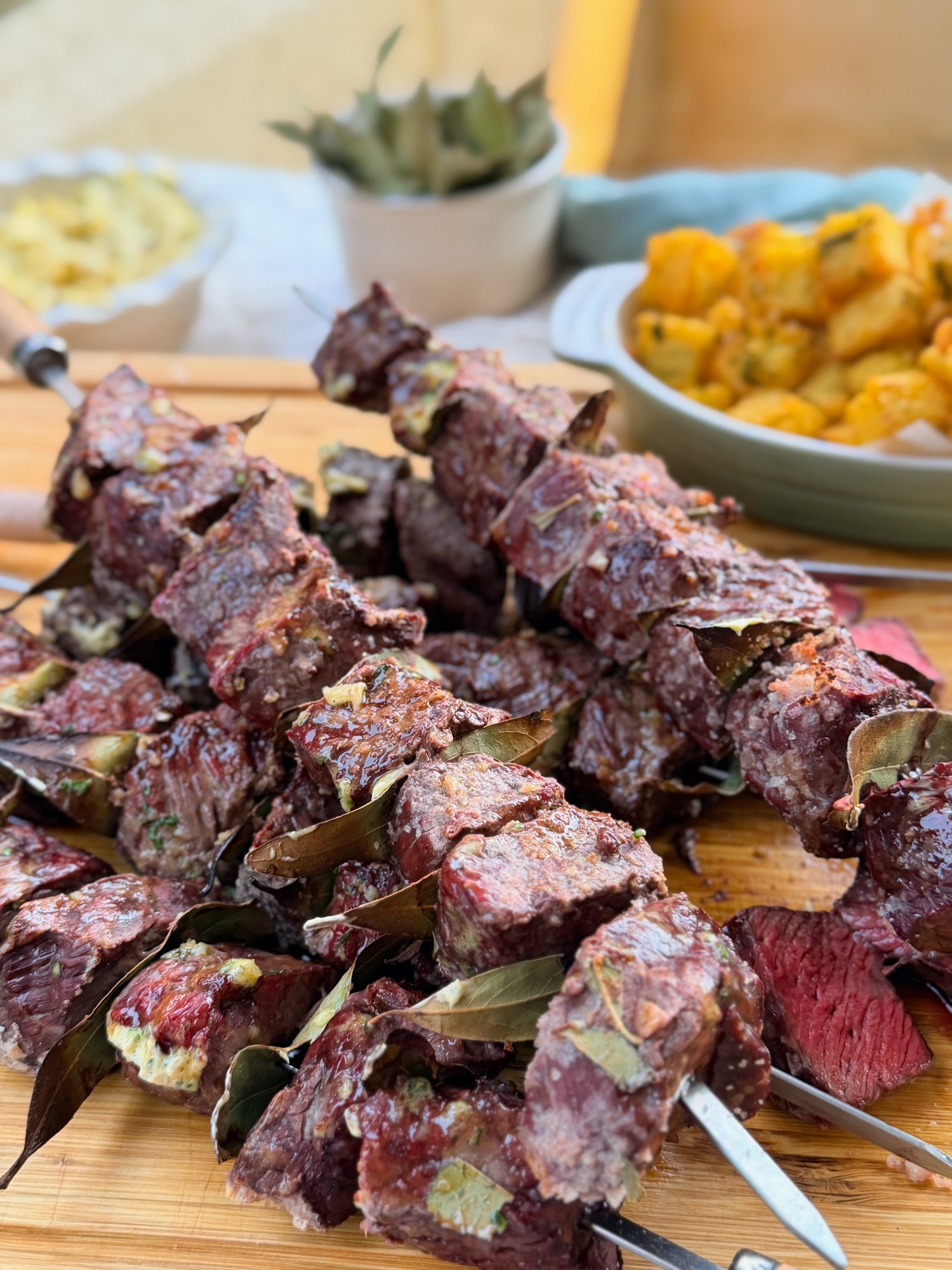
Espetada belongs to Madeira, and to Câmara de Lobos most of all, the fishing town on the island's south coast where my family was raised. For generations it was festival food. At the arraiais, the religious festivals held in villages across the island, beef was threaded onto freshly cut branches of bay laurel and cooked over open wood fires, so the meat carried the scent of the very tree it was skewered on. For many families, those festival days were among the rare times beef reached the table at all.
Espetada stayed outdoors until around 1950, when Francisco da Silva Freitas opened a small tavern in Estreito de Câmara de Lobos, in the hills just above the town, and built a dining room around the skewers and the fire. It is widely credited as the first espetada restaurant in Madeira, and others soon followed across the island. Over time the laurel branches gave way to iron skewers, and Milho Frito and bolo do caco, the island's soft round flatbread, joined the beef on the table. Because the restaurant tradition began there, espetada has been tied to Estreito ever since, and when I cook it, I am cooking something that belongs to the place my family comes from.
What makes espetada so good is how little it asks of you. Beef, garlic, bay and coarse salt, and nothing more. No wine, no vinegar, no paprika, no oil. The garlic and bay are crushed roughly into the salt and pressed onto the skewers just before they go over the coals, and the fire does the rest. The salt forms a crust that crackles as the outside darkens, the bay leaves curl and scorch at their edges, and the centre of each generous piece stays tender and juicy.
A word on doneness, because everyone has their own view on how espetada should be cooked. Some like it pink in the centre, others prefer it cooked well through, and there is no single right answer, so how you serve it is entirely your call. Cooking time depends on how large you cut the beef, how hot your coals are burning and how you like it served. When I cooked this batch, four long skewers of 4–5 cm pieces over a deep bed of glowing charcoal took about twelve minutes to reach medium-rare, turned four times. Treat that as a starting point rather than a rule, and let a meat thermometer and your own taste make the final judgement.
In Madeira, espetada is brought to the table and hung from a hook or iron stand, so the juices run down onto the bread below and everyone slides off their own pieces. Without a stand, a pastry brush and a dish of garlic butter do the job beautifully. Brush it over the skewers the moment they come off the fire and the butter melts straight into the beef, the garlic softening against the char and the salt. At our table it comes with crisp Milho Frito alongside, and it carries a little of Madeira with it wherever it is cooked.
Prep: 20 min · Cook: 12 min · Serves: 6 · Cuisine: Portuguese · Category: Beef
Ingredients
Espetada
- 2 kg beef rump or sirloin, trimmed of any heavy sinew
- 10 large garlic cloves, peeled
- 10–12 semi-dried bay leaves, for the seasoning
- A generous handful of extra semi-dried bay leaves, for threading
- 40 g coarse sea salt
Garlic Butter
- 125 g salted butter, softened
- 4 garlic cloves, finely grated
- 2 tbsp flat-leaf parsley, finely chopped
Method
- Light a charcoal fire and let it burn down until you have a strong, even bed of hot, glowing coals rather than open flames. Have four long metal skewers and a meat thermometer ready.
- Cut the beef into generous, even pieces of about 4–5 cm. Thread the beef onto the skewers, tucking a bay leaf between each piece as you go. Keep the pieces snug but not crammed, so the heat can reach every side.
- Roughly crush the garlic, the 10–12 bay leaves for seasoning and the coarse sea salt together, using a mortar and pestle or the flat of a heavy knife. Spread the seasoning over a tray and, just before cooking, roll each skewer through it, pressing gently so it clings to every side.
- Lay the skewers over the hot coals and turn them regularly so the beef colours evenly on all sides. Cooking time depends on the size of your pieces, the heat of your coals and how you like your beef. As a guide, 4–5 cm pieces over hot coals take about 12 minutes for medium-rare, turned four times.
- Start checking the internal temperature towards the end of cooking, pushing the thermometer into the centre of the thickest piece. For medium-rare, lift the skewers off the heat at 52–54°C.
- For medium, keep cooking for about 14–16 minutes in total and lift off at 57–60°C. For medium-well, cook for about 18–20 minutes in total and lift off at 63–65°C.
- Rest the skewers for 5 minutes. The temperature will keep rising as the beef rests: to about 55–57°C for medium-rare, 60–63°C for medium and 65–68°C for medium-well.
- Tap away any loose excess salt. Brush the hot skewers generously with garlic butter, or hang them from a stand if you have one, and bring them to the table with Milho Frito alongside.
- Mash the softened butter, garlic and parsley together with a fork until evenly combined.
- Spoon into a small dish and keep at room temperature until the espetada comes off the fire, so it melts easily.
- Brush the butter generously over the hot skewers as soon as they have rested, and set the dish on the table for anyone who would like more.
Serving Suggestion
Bring the espetada to the table on its skewers, hung from a stand if you have one, or simply laid on a warm board and brushed with garlic butter. Crisp Portuguese Milho Frito belongs alongside, and a basket of Portuguese Bread Rolls (Papo Secos) is very welcome for the buttery juices left behind. Garlic Chilli Lemon Broccolini brings something green and bright to the table, and for something to sip while the coals burn down, Madeira Poncha Two Ways keeps the whole meal on the island.
Storage and Make Ahead
Espetada is at its best straight from the fire. Leftover beef keeps in an airtight container in the fridge for up to 3 days and is lovely sliced thinly and eaten cold in a crusty roll, or warmed very briefly in a hot pan so it doesn't overcook. The beef can be cut and threaded onto skewers up to a day ahead and kept covered in the fridge, but add the garlic, bay and salt seasoning only just before cooking. The garlic butter keeps in the fridge for up to a week; bring it back to room temperature before serving.
Useful Questions
What is espetada? Espetada is Madeira's traditional beef skewer: large pieces of beef seasoned simply with garlic, bay leaves and coarse salt, then cooked over charcoal or wood embers. It began as festival food and is now one of the island's best known dishes.
Where does espetada come from? Espetada was cooked at Madeira's village festivals for generations before it moved indoors around 1950, when Francisco da Silva Freitas opened what is widely credited as the island's first espetada restaurant in Estreito de Câmara de Lobos. The dish has been closely tied to that parish ever since.
How should espetada be cooked? Doneness is a matter of personal taste, and espetada is enjoyed anywhere from medium-rare to medium-well. Cook it the way your table likes it, using the temperatures in the method as your guide.
How long does espetada take to cook? It depends on the size of the beef pieces, the heat of the coals and how you like it cooked. As a guide, 4–5 cm pieces take about 12 minutes for medium-rare, 14–16 minutes for medium and 18–20 minutes for medium-well, but a meat thermometer is the most reliable way to judge.
What cut of beef is best for espetada? Rump or sirloin are ideal because they are tender enough to cook quickly over high heat while staying juicy. Avoid slow-cooking cuts such as chuck or blade, which stay tough when cooked fast.
Can I cook espetada on a gas barbecue? Charcoal is traditional and gives espetada its smoky character, but a gas barbecue on high heat will still cook it well. Rely on the thermometer rather than the clock, as gas and charcoal heat quite differently.
Do I need a hanging stand to serve espetada? No. A stand is the traditional way to serve it, but laying the skewers on a warm board and brushing them with garlic butter works beautifully at home.
What is espetada served with in Madeira? It is traditionally served with milho frito (fried cornmeal cubes), bolo do caco (Madeiran flatbread) spread with garlic butter, and a simple salad.
Notes
Rump or sirloin are the best choices here. Cutting them into generous pieces rather than small kebab-sized cubes lets the centre stay tender while the outside colours over the coals.
Smaller pieces cook through much faster, so if yours are under 4 cm, start checking the temperature a few minutes earlier.
Semi-dried bay leaves are pliable enough to thread without snapping, yet still release that characteristic bay aroma as they heat. Fully dried leaves tend to crack and scorch quickly.
Check the temperature in the very centre of the thickest piece, away from the skewer. Metal skewers carry heat into the meat, so a reading taken right beside the skewer can be misleading.
Cook over glowing coals, never constant flames. If flare-ups start, move the skewers to a cooler part of the grill for a moment until they settle.
The coarse salt looks like a lot, but much of it falls away during cooking, and any excess is tapped off before serving.
Metal skewers become extremely hot over charcoal, so turn and lift them with tongs or a thick cloth.
The Grace Table Tip
When your table likes their beef cooked differently, cut a few pieces slightly larger and thread them onto their own skewer. Lift the smaller skewers off first for those who like medium-well to finish cooking, or take the larger ones off early for medium-rare, so everyone is served exactly how they like it from the same fire.
Lift the beef off at 52–54°C for medium-rare, 57–60°C for medium or 63–65°C for medium-well. It will rise a few more degrees as it rests.