Portuguese Christmas Ham with Madeira Glaze
A smoked Christmas ham glazed with aged Boal Madeira, treacle, orange, smashed garlic and bay, with warm spice and a touch of acidity. Brushed on in thin layers over a mild cherry wood smoke, the glaze builds into a dark, sticky, caramelised crust that brings the flavours of Madeira to an Australian Christmas table.
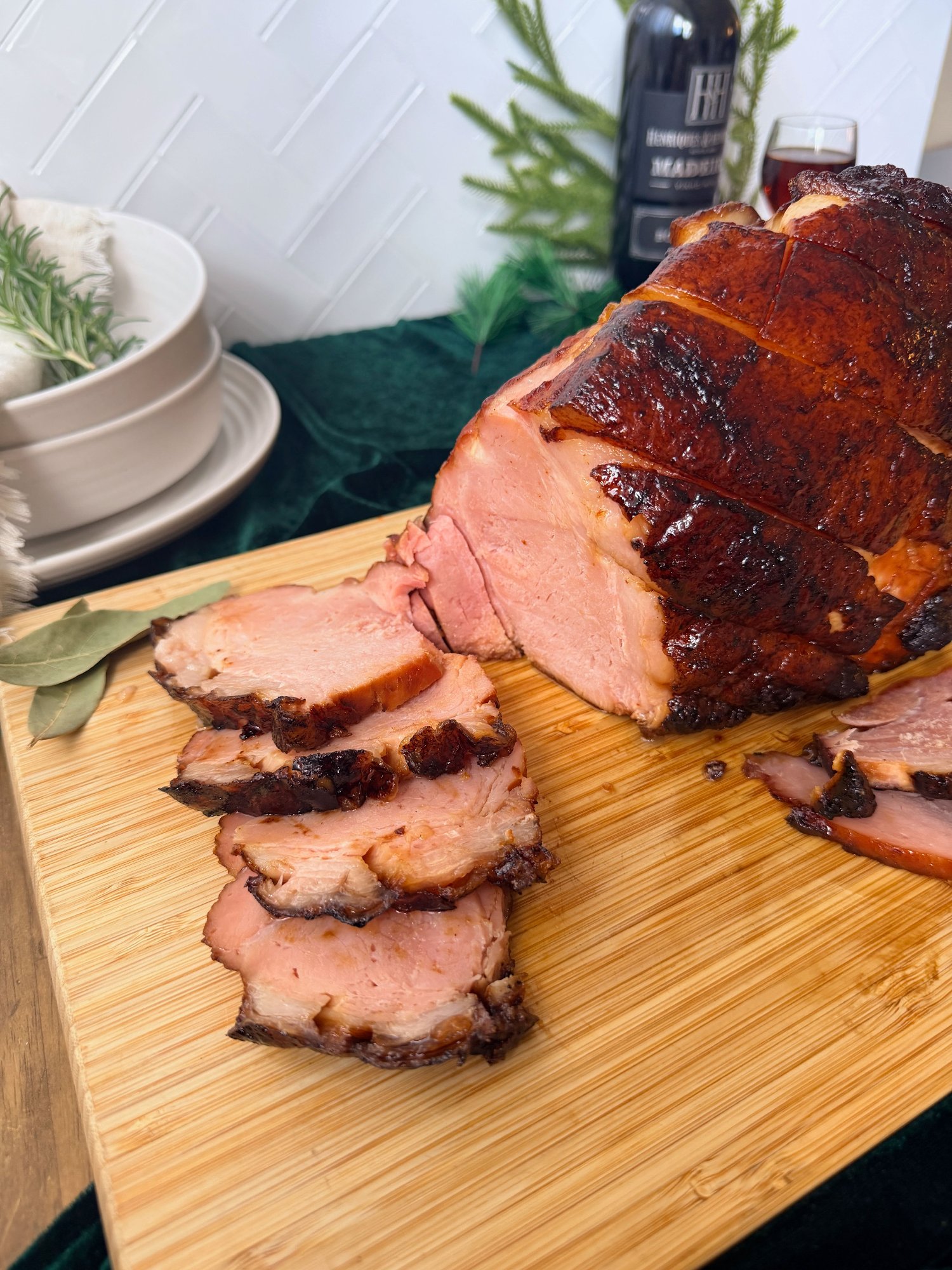
Wine, garlic and bay were the flavours of the Christmas pork I grew up with, and no Christmas passed without bolo de mel on the table. Both are part of the Portuguese heritage that has always shaped my cooking, and for this ham I wanted to bring them together on an Australian Christmas table, where a glazed ham takes pride of place.
The glaze starts with that familiar pairing of pork, wine, garlic and bay, then borrows from the cake we ate religiously every year. Bolo de mel gets its dark, rich sweetness from sugarcane, citrus and warm spice, and those same notes run through this glaze. A 10-year-old Boal Madeira from Câmara de Lobos, treacle, orange, smashed garlic, bay, cinnamon and clove come together in a thin glaze, brushed over a smoked ham in layers until it builds into a dark, glossy crust.
The Madeira is the heart of it. Boal has a gentle sweetness that never tips into sugary, with the nutty, caramelised depth that comes with age. Smashing the garlic lets it come through soft and rounded rather than sharp, and the bay adds a quiet aroma nothing else can give. The darkest peaks of the scored fat turn deeply caramelised without a trace of bitterness, and beneath them the ham stays moist right through. Carved cold with fresh orange alongside, it brings those Portuguese Christmas flavours to an Australian summer table.
Prep: 30 min · Cook: 115 min · Serves: 12 · Cuisine: Portuguese Australian · Category: Dinner
Ingredients
Smoked Ham
- 1 bone-in, ready-to-eat smoked leg ham portion, approximately 2.8–3 kg
- Cherry smoking wood, for a mild smoke
Madeira, Treacle, Orange & Bay Glaze
- 125 ml Boal Madeira (I use Henriques & Henriques 10 Year Old Boal; see Cook's Notes for substitutes)
- 75 g treacle
- 50 g dark brown sugar
- 60 ml fresh orange juice
- Finely grated zest of 1 orange
- 15 ml fresh lemon juice
- 15 ml red wine vinegar
- 2 garlic cloves, peeled and smashed
- 2 dried bay leaves
- 1 cinnamon stick
- 4 whole cloves
- ¼ tsp freshly cracked black pepper
Method
- Preheat the smoker to 165°C and add a small amount of cherry wood for a mild smoke.
- Remove the rind from the ham, leaving the layer of fat intact. Score the fat deeply in a diamond pattern, taking care not to cut too far into the meat.
- Place the ham fat-side up on a rack set over a foil-lined tray. Insert a temperature probe into the thickest part of the ham, keeping it away from the bone.
- Place the ham in the smoker and cook unglazed for 30 minutes to warm the surface and take on a little smoke.
- Brush the ham all over with a thin coat of the glaze, letting it run naturally into the scoring. Close the smoker and cook for 20 minutes.
- Apply a second thin coat and cook for a further 20 minutes. The glaze will begin to caramelise and the scored fat will start to open.
- Apply a third coat, concentrating on the paler areas rather than any edges that are already deeply caramelised. Cook for a further 25 minutes.
- Apply a fourth and final thin coat. If any raised points have become very dark, loosely cover only those spots with small pieces of foil.
- Continue cooking, watching closely, for around 20 minutes or until the thickest part of the ham reaches 62°C. Remove from the smoker.
- Rest uncovered for 15 minutes before carving or serving.
- Combine the Madeira, orange juice, orange zest, lemon juice, red wine vinegar, garlic, bay leaves, cinnamon, cloves and black pepper in a small saucepan.
- Bring to a gentle simmer and cook for 8–10 minutes to infuse the aromatics.
- Add the treacle and dark brown sugar and stir over gentle heat until completely dissolved.
- Simmer gently for a further 5–8 minutes. The glaze will stay thin and runny rather than becoming a thick syrup.
- Remove from the heat and leave to infuse for 10 minutes.
- Strain, discarding the garlic, bay, cinnamon and cloves. The glaze is now ready for brushing. You may have a little left over with a ham of this size.
Serving Suggestion
Serve the ham warm or cold as the centrepiece of a Christmas spread, making sure each slice carries some of the caramelised crust. Fresh orange alongside picks up the citrus in the glaze. For a full summer table, pair it with Crispy Smashed Potato Salad with Feta, Olives & Creamy Lemon Dressing and Australian Christmas coleslaw.
Storage Notes
If serving the ham cold, cool it promptly after cooking and refrigerate at 5°C or below. Keep it covered on a plate or in a container rather than a ham bag, as the sticky glaze will cling to the fabric. Carve only what you need and return the rest to the fridge within 2 hours. Wrapped leftover slices keep in the fridge for up to 3 days, and slices or the ham bone can be frozen. Cold ham is not recommended for pregnant women, people with weakened immune systems or anyone over 70 unless reheated thoroughly and eaten hot.
Notes
Choosing your Madeira. I use Henriques & Henriques 10 Year Old Boal from Câmara de Lobos, and it is what makes this glaze. Boal, also sold as Bual, sits in the middle of the Madeira styles: sweet without being sugary, with a nutty, caramelised depth that comes with age. If you can't find it, look first for another Boal or Bual, or a Rainwater or 5 Year Old Madeira, which are often easier to come by. Malmsey (Malvasia) Madeira works too, but it is richer and sweeter, so ease back a little on the brown sugar. Sercial and Verdelho are too dry for this glaze. If you can't find any Madeira, a good tawny port is the closest swap. It brings the same nutty, caramelised notes with a little more fruit. A sweet Apera or a sweet Marsala will also work. Use the same 125 ml. Avoid anything labelled cooking wine, and steer clear of very rich muscats and topaques, which tip the glaze from balanced into cloying.
For an alcohol-free glaze, replace the Madeira with 100 ml unsweetened red grape juice and 1 tablespoon of balsamic vinegar. The glaze will be lighter and fruitier, without the depth Madeira brings, but the garlic, bay, orange and spice still carry it.
Smash the garlic rather than slicing or crushing it finely. It releases a soft, rounded garlic flavour into the glaze without any sharpness.
Treacle stands in for the dark sugarcane character of Madeiran mel de cana. Its slight bitterness balances the brown sugar and orange so the glaze tastes rich rather than simply sweet.
The ham is already smoked, so keep the cherry wood smoke mild. It should sit quietly behind the Madeira, orange and spice.
The glaze is intentionally runny. It settles into the scoring and caramelises into a sticky lacquer, where a thick glaze would sit on the surface and burn. There is no need to reduce it further.
As a guide, our 2.9 kg ham read 16°C inside at the first coat, 29°C at the second, 37°C at the third and 51°C at the fourth, finishing at 62°C. It stayed beautifully moist at that temperature.
For a larger ham, make extra glaze (a double batch is a good starting point for a full leg) and allow a longer cook with the same rhythm of thin coats. The probe tells you when it is done, not the clock.
The Grace Table Tip
Give the ham time between each coat of glaze rather than brushing continuously. Each layer needs enough heat to caramelise and set before the next goes on, building a dark lacquered crust without loading the surface with sugar. Let colour decide the final coat: if the peaks are already very dark, a light brush over the paler areas is all it needs.
No smoker? Use the oven at 165°C conventional or 150°C fan-forced, with the ham on a rack over a foil-lined tray and 250 ml of water in the tray to stop drips scorching. Follow the same glazing rhythm, finish at 62°C and check the peaks from the third coat. The ham is already smoked, so it keeps a gentle smokiness.