Low and Slow Smoked Beef Brisket
Low and slow smoked brisket with a rich, dark bark, rendered fat, and tender slices finished with the cooking juices. This is a deeply savoury cook that turns a beautiful cut of beef into something soft, juicy, and full of flavour.
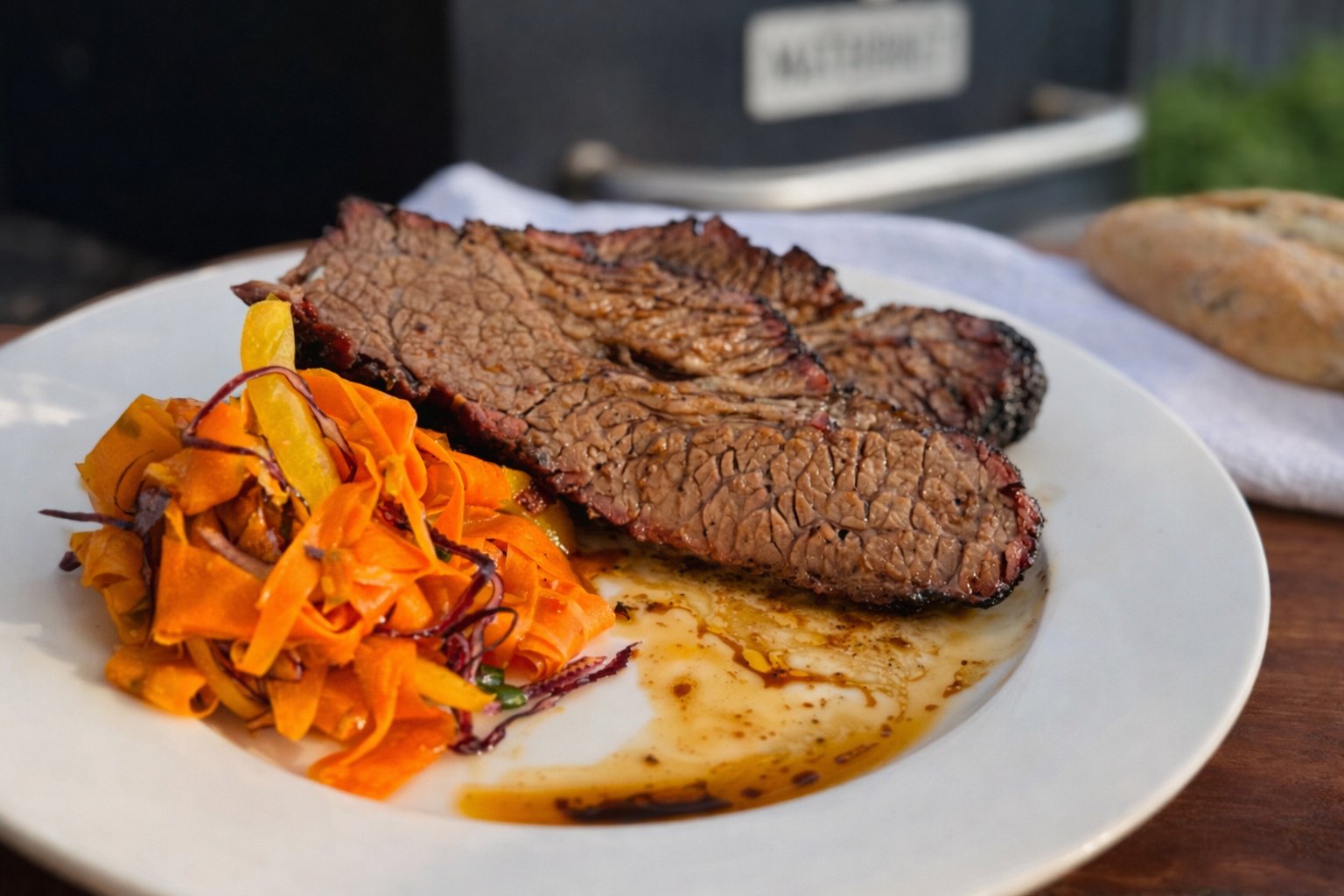
Brisket is my favourite cut to smoke. There is something so satisfying about the way it transforms over time. What begins as a large, firm piece of beef slowly softens as the fat renders down, the seasoning darkens into a bark, and the meat becomes juicy, tender, and deeply flavoured.
I cook mine on a Masterbuilt Gravity Series smoker, which makes it easy to hold a steady low temperature over a long cook while still building that deep colour and flavour on the bark. For seasoning, I use Rib Rack’s Black Cow, which gives the brisket a rich, savoury coating that works beautifully with the smoke and rendered fat.
This is a cook that rewards patience. The brisket is smoked low and slow, spritzed throughout to help the bark develop, then wrapped once it reaches the stall so it can continue gently through to that perfect stage where the probe slides in with almost no resistance.
For me, brisket is all about that balance between dark bark and soft, juicy meat. When it is sliced and finished with the rich juices from the tray, it is everything I love about slow cooking and smoking in one dish.
I love serving this brisket with my Rainbow Ribbon Salad with Sesame, Chilli & Lime, which brings freshness, crunch, and brightness alongside the rich, smoky meat.
Prep: 20 min · Cook: 600 min · Serves: 10 · Cuisine: Australian · Category: Beef
Ingredients
- 1 whole beef brisket, approximately 3.1kg
- Rib Rack’s Black Cow seasoning, enough to generously coat the brisket
- 1/2 bottle full strength beer
- 4 good splashes balsamic vinegar
Method
- Preheat your smoker to 225°F / 107°C and allow it to settle at a steady temperature before adding the brisket.
- Trim the brisket, removing any hard fat while leaving the softer fat intact so it can render during the cook.
- Coat the brisket generously all over with Rib Rack’s Black Cow seasoning, making sure the surface is fully covered.
- Place the brisket into the smoker. You can either place it directly on the middle rack with an aluminium tray underneath, or place a roast rack inside an aluminium tray and set the brisket on top.
- In a spray bottle, combine the full strength beer and balsamic vinegar to make your spritz mixture.
- Smoke the brisket, spritzing every 30 to 45 minutes to help keep the surface moist and support the development of the bark.
- After about 4 hours, begin checking the internal temperature. Once the brisket reaches around 150°F to 167°F / 65°C to 75°C, place it into the aluminium tray if it is not already there, add 50 to 100ml of the spritz mixture, and cover the tray tightly with foil. This method is known as boating, and helps the brisket cook through the stall while holding onto moisture.
- Return the covered brisket to the smoker and continue cooking for another 2 1/2 to 3 hours, or until the internal temperature reaches around 205°F / 96°C.
- Once it reaches temperature, check for doneness by probing the meat. The probe should slide in with very little resistance, almost like softened butter. If it still feels firm, continue cooking until it is ready.
- When the brisket is ready, remove the top foil and leave it in the smoker for a final 20 minutes to help firm the bark slightly.
- Remove the tray from the smoker and leave the brisket uncovered on the bench for 5 minutes to allow some of the steam to escape.
- Cover the tray again with foil and transfer it to an oven set to 194°F / 90°C for 2 to 2 1/2 hours to rest and hold warm.
- Slice the brisket, drizzle over some of the cooking liquid from the tray, then serve.
Notes
Hard fat will not render properly, so it is worth trimming away while leaving the softer fat in place.
The balsamic vinegar helps develop that deep colour on the bark, and the natural sugar in it helps the rub hold to the meat as it cooks, creating a bark that is rich, slightly sticky, and never dry.
Internal temperature is a guide, but the real sign a brisket is ready is how it feels when probed.
This recipe was cooked on a Masterbuilt Gravity Series smoker, though the method can be used on other smokers that can comfortably hold a steady low temperature.
Resting the brisket properly is essential for tender slices and juicy meat.
Serve alongside Portuguese Bread Rolls (Papo Secos), to soak up all the delicious juices.
The Grace Table Tip
Do not rush the rest. Holding the brisket warm after smoking gives the meat time to relax and reabsorb its juices, making every slice more tender and more flavourful.