Homemade Fruit Mince
Sultanas, currants and dried apricots blitzed with grated Granny Smith, dark brown sugar, warm spices, citrus zest and juice, then loosened with brandy and orange liqueur. Made without suet and without cooking, it rests overnight in the fridge and becomes the base for mince pies, tarts and Christmas baking.
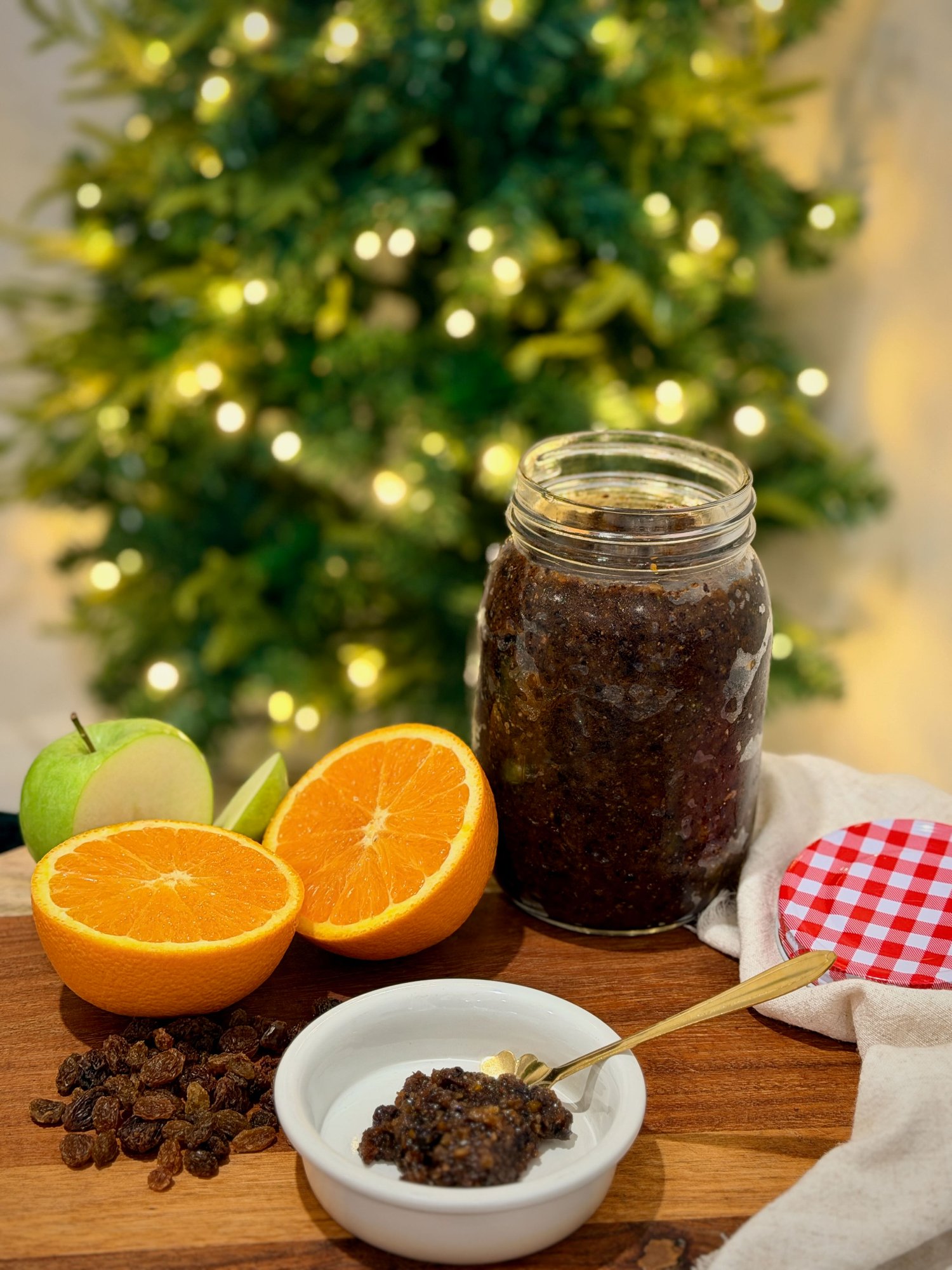
A jar of fruit mince sitting in the fridge from early December is one of the quiet signs that Christmas has properly started in our house.
The fruit goes into the processor in short bursts, never long enough to turn it to paste. That is the part worth paying attention to. You want the sultanas broken down enough to release their sweetness, the apricots reduced to small glossy flecks, and enough texture left that you can still see what went into it. Grated Granny Smith keeps it from becoming cloying, and the zest and juice of a whole orange and a whole lemon lift the whole thing so the spice sits behind the fruit rather than on top of it.
There is no suet here, which means it is vegetarian and considerably lighter than the traditional version. The brandy and orange liqueur are not there for heat, they are there to carry the flavour and to help everything settle together as it rests. By the next morning the sugar has dissolved completely, the spices have softened, and the mixture has darkened into something glossy and deeply fragrant.
Prep: 15 min · Yield: 1 Litre jar · Cuisine: Australian · Category: Baking
Ingredients
Homemade Fruit Mince
- 300 g sultanas
- 250 g currants
- 200 g dried apricots, finely chopped
- 1 large Granny Smith apple, peeled and grated
- 150 g dark brown sugar
- Zest and juice of 1 orange
- Zest and juice of 1 lemon
- 1 tsp ground cinnamon
- 1 tsp mixed spice
- ¼ tsp ground cloves
- ¼ tsp ground ginger
- 60 ml (¼ cup) orange liqueur, such as Cointreau
- 60 ml (¼ cup) brandy
Method
- Sterilise a 1 litre jar and its lid. Wash in hot soapy water, rinse well, then dry in a 120°C oven for 15 minutes. Set aside to cool.
- Put the sultanas, currants and chopped apricots into the bowl of a food processor.
- Pulse in short bursts, scraping down the sides once or twice, until the fruit is broken down but still textured. Stop well before it becomes a paste. You should still be able to see individual pieces of fruit.
- Add the grated apple, dark brown sugar, orange zest and juice, lemon zest and juice, cinnamon, mixed spice, cloves and ginger.
- Pulse two or three times, just enough to bring everything together. Do not over process at this stage.
- Pour in the orange liqueur and brandy, then pulse once more or stir through by hand until evenly combined.
- Spoon into the cooled sterilised jar, pressing down gently to remove air pockets. Wipe the rim clean and seal.
- Refrigerate for at least 24 hours before using, so the sugar dissolves fully and the spices settle into the fruit.
Why This Fruit Mince Is Different
Mention fruit mince to most people under fifty and you will get a face. Our generation grew up on the version that came out of a jar: dark, heavy, oversweet, and tasting mostly of dried fruit that had been sitting too long. It was food made for a much older crowd, and an entire generation decided they did not like fruit mince when what they actually did not like was that particular jar.
This recipe has been reworked over twenty years of Christmas baking, and the changes were all in the same direction. More citrus, less sugar, apricots for brightness, fresh grated apple for lift, and no suet at all. The result still tastes unmistakably of Christmas, warm with cinnamon and cloves, but it is vibrant rather than heavy, and the orange and lemon come through clearly. It has won over a great many people who were certain they did not like fruit mince, most of them young.
It is worth keeping a jar for more than pies. Served on a cheese board in place of quince paste it works beautifully against a sharp cheddar or a blue, and it disappears far quicker than the quince ever did. Brushed over a glazed ham in the last stretch of roasting, it caramelises into something quite extraordinary.
Storage & Make Ahead
Keep the sealed jar in the fridge and use within two weeks. Always use a clean dry spoon each time you take some out, as any moisture or crumbs introduced into the jar will shorten its life. The mixture is at its best after at least 24 hours of resting, so make it a day or two ahead of any baking you have planned rather than using it straight away. It has not been tested for freezing, so the fridge is the recommended storage.
Useful Questions
Does fruit mince contain meat?
No. The name is a leftover from centuries ago, when mincemeat genuinely did contain meat alongside the dried fruit and spices. Modern fruit mince is entirely fruit based, and this version contains no meat and no suet, so it suits vegetarians.
Do I need to cook it?
No cooking at all. The fruit softens and the sugar dissolves during the resting time in the fridge, which does the work that cooking would otherwise do. That resting time is the only step you cannot rush.
Can I make it without alcohol?
Yes. Replace the brandy and orange liqueur with the same total quantity of fresh orange juice. The flavour will be brighter and fresher rather than deep and warming, and because the alcohol also helps preserve the mixture, use it within one week rather than two.
Why is there no suet?
Traditional fruit mince uses suet for richness and to help it keep. Leaving it out gives a lighter, fruit forward mixture that tastes cleaner in a pie, and it means the recipe works for vegetarians without any substitution.
Serving Suggestion
The obvious home for this is fruit mince pies and tarts, though a jar earns its keep in other ways through December. Spoon it warm over vanilla ice cream, stir a little through thick Greek yoghurt at breakfast, or fill baked apples with it and bake until soft. It is very good rolled into scrolls with puff pastry for something quick when people arrive unannounced. For everything else that goes on the table around it, the whole Christmas collection sits together on one page.
Notes
Short bursts in the processor are the whole technique. Long continuous processing turns the fruit into a dark paste, and once that happens there is no fixing it.
Grate the apple just before you use it so it does not brown. There is enough citrus juice in the mixture to keep it looking fresh once combined.
Use the zest before you juice the fruit. Zesting a squeezed half is awkward and you lose most of it.
Taste after resting rather than on the day you make it. On day one the spices sit sharply on top, and by day two they have settled into the fruit completely.
If the mixture looks a little dry after resting, stir through an extra tablespoon of orange juice. Dried fruit absorbs more liquid overnight than you expect.
The Grace Table Tip
A jar of this makes a genuinely good gift in the week before Christmas. Fill a clean 250 ml jar, tie a length of kitchen string around the neck, and write "keep refrigerated, use within two weeks" on the label so whoever receives it knows to treat it as fresh rather than shelf stable.