Classic Pavlova
A classic pavlova with a thin crisp shell, a deep soft centre and a base that lifts cleanly from the paper, topped with whipped cream cheese cream and fresh berries. Made for Christmas, summer celebrations and long lunches with family.
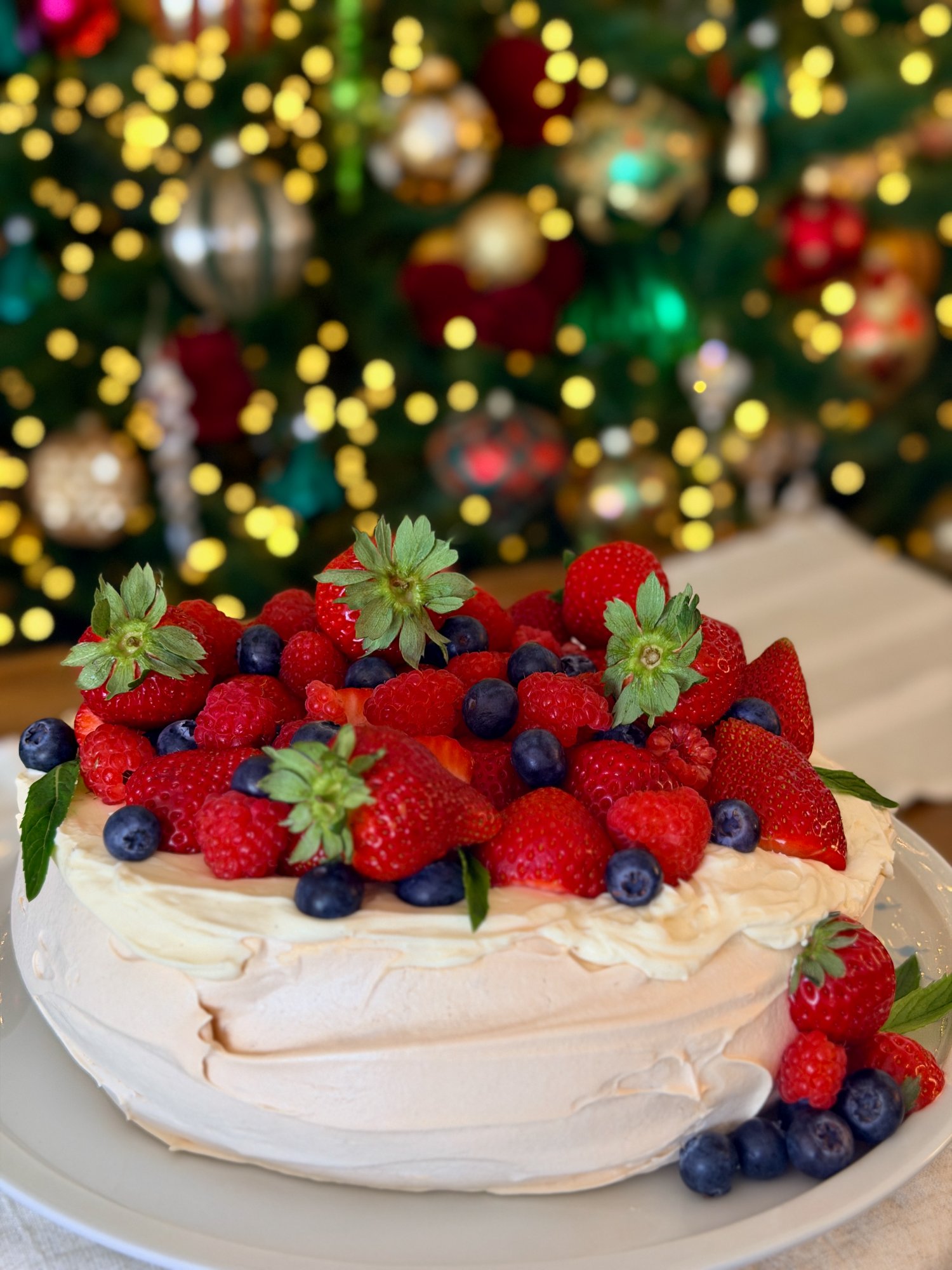
A tall white pavlova has been part of my Christmas table for as long as I have been baking, and after more than twenty years I still shape every one the same way. I trace around a small side plate on the back of the baking paper, then build the meringue inside that circle with a flexible spatula I have had for nearly eighteen years. I press out every pocket of air and smooth the sides up straight, the way you would crumb coat a cake. That care is what gives this pavlova its height: a thin crisp shell, a base that lifts cleanly from the paper, and a deep marshmallow centre that stays soft right through.
I top mine with cream whipped together with a little cream cheese, vanilla bean and icing sugar. It holds its shape on the table, never melts away into the meringue before serving, and its gentle tang balances the sweetness. Finished with a generous pile of strawberries, raspberries and blueberries, it belongs at every summer celebration.
If you would like to understand the why behind every step, from cracking and weeping to how your own oven behaves, my pavlova guide holds everything I know.
Prep: 30 min · Cook: 90 min · Serves: 8 · Cuisine: Australian · Category: Desserts
Ingredients
Pavlova
- 175g egg whites (about 5 eggs), at room temperature
- 260g caster sugar
- 1 tsp cornflour (100% maize for gluten free)
- 1 tsp white vinegar, plus a little extra for wiping the bowl
- ½ tsp vanilla extract
Cream Cheese Cream
- 250g cream cheese, softened
- 45g icing sugar mixture
- ½ tsp vanilla bean paste
- 300ml thickened cream, cold
To Serve
- 250g strawberries
- 125g raspberries
- 125g blueberries
- Fresh mint leaves, to garnish
Method
- Preheat the oven to 150°C on the conventional (Bake) setting, or 130°C fan forced, with a shelf in the middle. Trace around a 16cm side plate on a sheet of baking paper, turn the paper over so the pencil faces down, and lay it on a thin, light coloured baking tray.
- Wipe a large glass or metal mixing bowl and the whisk with a paper towel dampened with a little white vinegar, to remove any trace of grease.
- Add the egg whites and whisk on medium speed until they turn white and hold soft peaks that curl over at the tip.
- With the mixer still running on medium, add the caster sugar one spoonful at a time, letting each spoonful disappear before adding the next.
- Keep whisking until the meringue is thick, very glossy and holds a stiff, upright peak. Rub a little between your thumb and finger: it should feel completely smooth, with no grit at all. If you can feel sugar, keep whisking and test again.
- Sprinkle over the cornflour, add the vinegar and vanilla, and whisk briefly, just until combined.
- Dab a little meringue under each corner of the baking paper to hold it flat. Spoon the meringue into the traced circle.
- Using a flexible spatula, scoop the meringue inward, then press it down and under so each pocket of air collapses. Work around the pavlova until the whole mound feels solid and even. Smooth the sides up straight and tall, and leave a gentle dip in the top for the cream.
- Place the pavlova in the oven and immediately reduce the temperature to 120°C (100°C fan forced). Bake for 90 minutes without opening the door.
- Turn the oven off and leave the pavlova inside, with the door closed, until completely cool, at least 2 hours or overnight.
- Once cool, slide a flat serving plate alongside the tray and ease the pavlova across, peeling the paper back as you go.
- Beat the softened cream cheese with the icing sugar mixture and vanilla bean paste until completely smooth.
- Add the cold thickened cream and whip until it holds soft, billowy peaks.
- Just before serving, spoon the cream cheese cream into the dip on top of the pavlova.
- Pile the berries over the cream, leaving some strawberries whole and halving others. Let a few tumble onto the plate, and finish with a few mint leaves.
Serving Suggestion
For a Christmas table, serve this pavlova after the Portuguese Christmas Ham with Madeira Glaze, with a Lychee and Elderflower Martini or a Tiramisu Martini for the grown ups. For everything I know about pavlova, from cracking and weeping to humidity and making ahead, my pavlova guide answers the questions you have sent me.
Storage & Make Ahead
The undressed pavlova can be baked the day before, or up to two days ahead in cool, dry weather. Store it in a large airtight container at room temperature, and never in the fridge, as the humidity softens the shell. Once dressed, it is best eaten within an hour or two; leftovers keep covered in the fridge until the next day, though the shell will soften.
Useful Questions
Why did my pavlova crack? A few fine cracks are normal as the soft centre settles, and the cream covers them completely. Large cracks usually mean the oven was too hot, the door was opened, or the pavlova cooled too quickly, so keep the door closed and let it cool in the oven.
Why is my pavlova weeping? Weeping is almost always undissolved sugar. Add the sugar slowly and keep whisking until the meringue feels completely smooth between your fingers.
Can I make pavlova the day before? Yes. Bake it the day before, store it airtight at room temperature, and add the cream and fruit just before serving.
Is pavlova gluten free? It is, as long as your cornflour is 100% maize. Some Australian cornflour is made from wheat, so check the packet.
Notes
Weigh the egg whites rather than counting eggs, as egg sizes vary a great deal. 175g is about five eggs.
Use icing sugar mixture in the cream, not pure icing sugar. The little cornflour in the mixture helps the cream hold its shape.
For a lactose-free pavlova, use lactose-free cream cheese and lactose-free thickened cream, such as Zymil, measure for measure. It whips and holds exactly the same.
Line the tray with baking paper, not greaseproof paper. Greaseproof has no non-stick coating, so the meringue bonds to it and tears.
Expect the pavlova to grow from 16cm to about 20cm as it bakes, with a crisp base and a soft marshmallow centre.
For a chewier pavlova, spread the same meringue lower and wider. It will cook through faster, so it needs less time in the oven.
The Grace Table Tip
Pat the berries completely dry and cut the strawberries at the very last moment, just before the pavlova goes to the table. Any juice runs straight into the cream and softens the meringue, so dry fruit keeps the shell crisp for longer.
Baked on the conventional (Bake) setting. If your oven is fan forced only, use 130°C, then 100°C.