Chocolate Collared Christmas Pavlova
A tall, crisp pavlova wrapped in a collar of dark chocolate and white chocolate lace, filled with cream cheese cream and piled with fresh berries. A Christmas showstopper for the dessert table, made entirely at home.
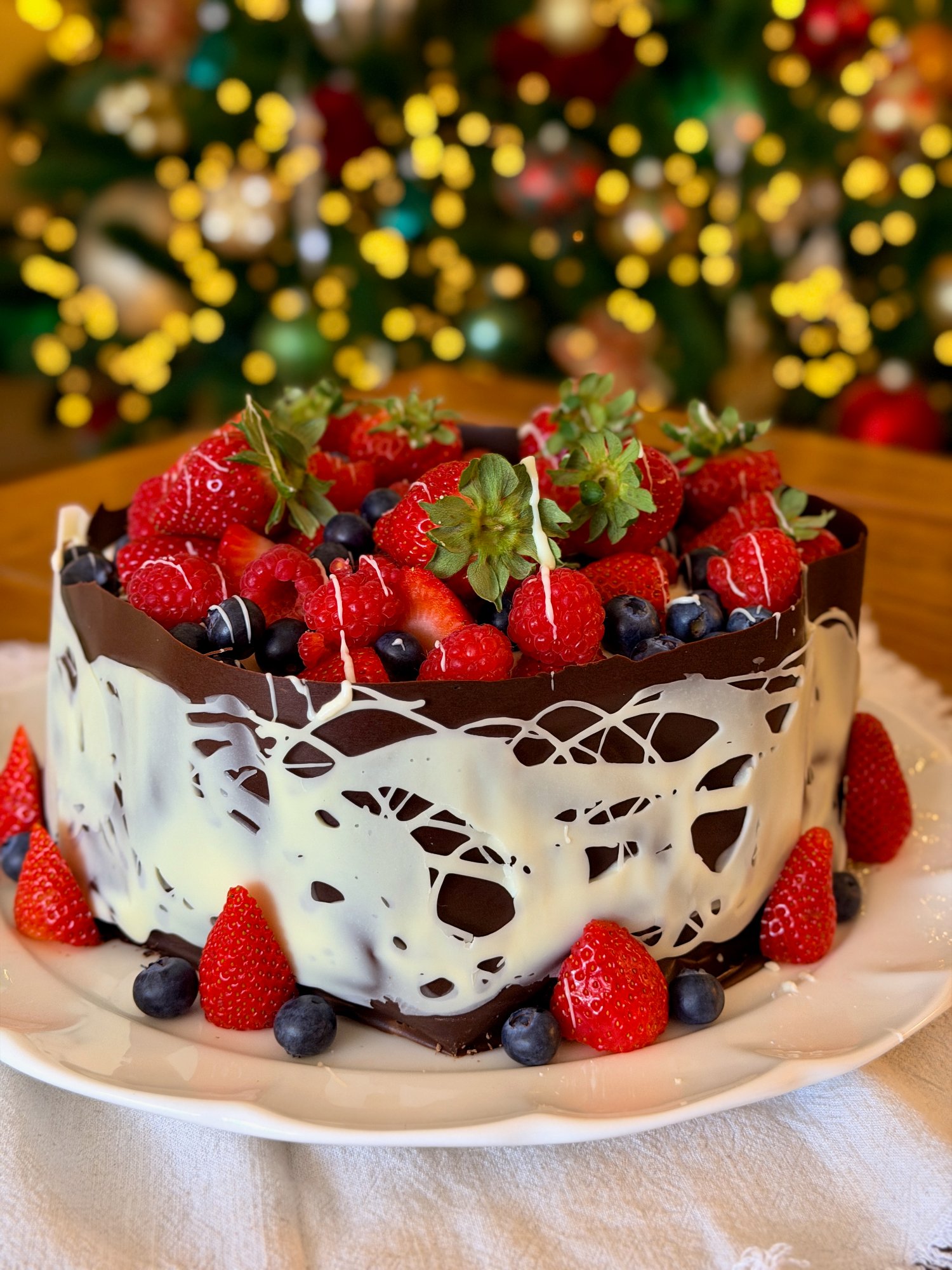
<p>Christmas at our table calls for one dessert that stops the room, and this is the pavlova my family asks for every year. It starts with the same meringue as my Classic Pavlova, baked with a hotter start so the sides rise taller and crisper, strong enough to hold a wall of chocolate. After more than twenty years of decorating cakes, wrapping a collar is one of my favourite finishing touches: dark chocolate spread thin on acetate and pressed gently around the shell, then a second layer of white chocolate lace drizzled over the top. When the acetate peels away, it leaves a glossy, patterned wall that looks like it came from a patisserie window.</p><p>Inside, it is filled with my cream cheese cream, which holds its shape beautifully, and finished with strawberries, raspberries and blueberries and a last drizzle of white chocolate. It looks far more difficult than it is, and the collar can be built in sections if you would rather take it slowly. If you would like to understand the why behind every step of the meringue, my pavlova guide holds everything I know.</p>
Prep: 60 min · Cook: 75 min · Serves: 8 · Cuisine: Australian · Category: Baking
Ingredients
Pavlova
- 175g egg whites (about 5 eggs), at room temperature
- 260g caster sugar
- 1 tsp cornflour (100% maize for gluten free)
- 1 tsp white vinegar, plus a little extra for wiping the bowl
- ½ tsp vanilla extract
Chocolate Collar
- 225g dark chocolate baking melts (I use Nestlé Melts)
- 150g white chocolate baking melts (I use Nestlé Melts), plus the leftovers for drizzling
- 2 strips of acetate, or baking paper folded double, long enough to wrap around the pavlova with a little overlap and about 4cm taller than its sides
Cream Cheese Cream
- 250g cream cheese, softened
- 45g icing sugar mixture
- ½ tsp vanilla bean paste
- 300ml thickened cream, cold
To Serve
- 250g strawberries
- 125g raspberries
- 125g blueberries
- Leftover melted white chocolate, for drizzling
Method
- Preheat the oven to 200°C (390°F) fan forced, with a shelf in the middle. Trace around a 16cm side plate on a sheet of baking paper, turn the paper over so the pencil faces down, and lay it on a thin, light coloured baking tray.
- Wipe a large glass or metal mixing bowl and the whisk with a paper towel dampened with a little white vinegar, to remove any trace of grease.
- Add the egg whites and whisk on medium speed until they turn white and hold soft peaks that curl over at the tip.
- With the mixer still running on medium, add the caster sugar one spoonful at a time, letting each spoonful disappear before adding the next.
- Keep whisking until the meringue is thick, very glossy and holds a stiff, upright peak. Rub a little between your thumb and finger: it should feel completely smooth, with no grit at all. If you can feel sugar, keep whisking and test again.
- Sprinkle over the cornflour, add the vinegar and vanilla, and whisk briefly, just until combined.
- Dab a little meringue under each corner of the baking paper to hold it flat. Spoon the meringue into the traced circle.
- Using a flexible spatula, scoop the meringue inward, then press it down and under so each pocket of air collapses. Work around the pavlova until the whole mound feels solid and even. Smooth the sides up straight and tall, and leave a gentle dip in the top for the cream.
- Place the pavlova in the oven and immediately reduce the temperature to 120°C (250°F) fan forced. Bake for 75 minutes without opening the door.
- Turn the oven off and leave the pavlova inside, with the door closed, until completely cool, at least 2 hours or overnight.
- Once cool, slide a flat serving plate alongside the tray and ease the pavlova across, peeling the paper back as you go.
- Melt the dark chocolate in a heatproof bowl in the microwave in 30 second bursts, stirring well between each, until smooth.
- Lay one strip of acetate on a clean bench. Using an offset spatula, spread the dark chocolate along the strip in an even layer, letting the top edge stay a little rough and natural.
- While the chocolate is still soft, lift the strip and wrap it around the pavlova, chocolate side in, pressing gently so it sticks to the shell. Overlap the ends slightly.
- Place the pavlova in the freezer for 5 minutes, until the chocolate has set. Peel the acetate away carefully. It should come away cleanly.
- Melt the white chocolate the same way. Lay the second strip of acetate on the bench and drizzle the white chocolate across it in loose, overlapping lines, filling in some areas more than others to create a lace pattern.
- While the white chocolate is still soft, wrap it around the dark collar, pressing gently. Freeze for another 5 minutes, then peel the acetate away.
- Keep the leftover white chocolate warm for drizzling over the berries.
- Beat the softened cream cheese with the icing sugar mixture and vanilla bean paste until completely smooth.
- Add the cold thickened cream and whip until it holds soft, billowy peaks.
- Spoon the cream cheese cream into the pavlova, inside the chocolate collar.
- Pile the berries over the cream, leaving some strawberries whole and halving others. Scatter a few more berries around the base of the plate.
- Drizzle the leftover white chocolate over the berries in fine lines, and serve.
Serving Suggestion
For a Christmas table, serve this after the Portuguese Christmas Ham with Madeira Glaze, with a Christmas Lemon Meringue and Shortbread Martini or a Lychee and Elderflower Martini for the grown ups. For a simpler pavlova, my Classic Pavlova uses the same meringue and cream with a gentler bake, and my pavlova guide answers every question you have sent me about cracking, weeping and making ahead.
Storage & Make Ahead
The undressed pavlova can be baked the day before and stored in a large airtight container at room temperature, never in the fridge. Wrap the collar and dress the pavlova on the day you serve, ideally within a few hours. Keep it somewhere cool until serving, as chocolate softens quickly on a warm day, and store any leftovers covered in the fridge.
Useful Questions
Why does this pavlova bake at a higher temperature? The hotter fan forced start sets the shell quickly, giving taller, crisper sides that are strong enough to hold the weight of a chocolate collar. A few cracks on top are normal and are hidden completely by the cream and berries.
Can I make the collar in sections? Yes. If wrapping one long strip feels daunting, spread the chocolate on two or three shorter strips and wrap them one at a time, overlapping each section slightly. The white chocolate lace hides the joins.
Do I need acetate? Acetate gives the glossiest finish and peels away most easily, but baking paper folded double works well too. Doubling it helps it hold the weight of the chocolate.
Is this pavlova gluten free? The meringue and cream are naturally gluten free when you use 100% maize cornflour. Check the label of your chocolate melts too.
Notes
Wrap the chocolate while it is still soft, so it sticks to the pavlova shell. If it has started to set, it will crack instead of bending.
Press the collar on gently with flat hands. The shell is crisp, and firm pressure can crack it.
If the acetate does not peel away easily, return the pavlova to the freezer for another minute or two.
Use icing sugar mixture in the cream, not pure icing sugar. The little cornflour in the mixture helps the cream hold its shape.
Weigh the egg whites rather than counting eggs, as egg sizes vary a great deal. 175g is about five eggs.
The Grace Table Tip
To cut neat slices through the chocolate collar, warm a large sharp knife under hot water, dry it, and cut with one firm downward press. Wipe and warm the knife again between slices, and the chocolate will break cleanly rather than shattering.
Baked fan forced on purpose: the hotter start gives the tall, crisp sides the collar needs. For a gentler conventional bake, see my Classic Pavlova.